This is a time of deep disillusionment, whether in response to politics, the economy, the increasingly divisive nature of social media algorithms, the promise/threat of AI, or the many conflicts around the world. I recently read two books that explore some of those sources of discontent with intelligence and wit. They’ll make you alternate between laughing and grimacing with recognition or contempt. And they’ll make you feel less alone in your existential dread.
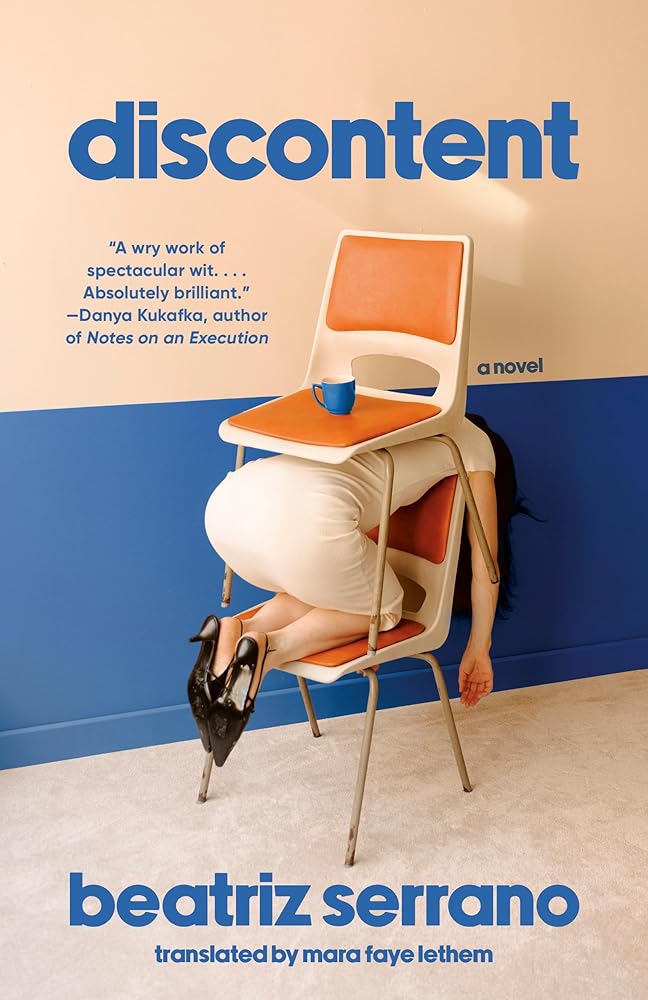
Discontent — Beatriz Serrano (translated by Mara Faye Lethem)
Vintage: Sept. 2, 2025
192 pages, $17.00
I discovered Discontent when it was a Book of the Month Club selection for September. Earlier this year, BOTM began a new initiative called The Collection, featuring a book from independent or international publishers, and this short novel by Spanish writer Beatriz Serrano was an inspired choice. Although it’s set in Madrid, it captures the nearly universal disenchantment experienced by those in the corporate world. From the outside, Marisa appears to have it all: she’s a middle manager at an advertising agency, lives in a nice apartment in a high-rise building, and has a convenient male friend a few floors away. But she hates her job, despises most of her co-workers, and has developed an anxiety disorder.
Discontent follows Marisa through various encounters that brilliantly depict everything people hate about modern work life. She is an expert at pretending to be busy, speaking in corporate jargon when necessary, and managing to produce (or steal) work that is competent enough to keep her employed. She often finds reasons to leave the office and go to the museum or a restaurant. It’s an alternately cringeworthy and hilarious story; my copy has a couple dozen Post-It flags marking the times Serrano completely nailed the many torturous aspects of corporate life or made me laugh out loud. The situation goes from bad to worse when the company plans a team-building retreat in the Segovia forest. (Ugh! Kill me now.) Suffice to say, things spin out of control. I don’t want to say any more than that and spoil the fun.
While I enjoyed Discontent, it was also a little like reading a snarky blog. It’s very episodic and the close first-person narrative felt claustrophobic at times. But most of the time it’s a darkly humorous read full of incisive observations. [See two excerpts at the bottom of this post.]
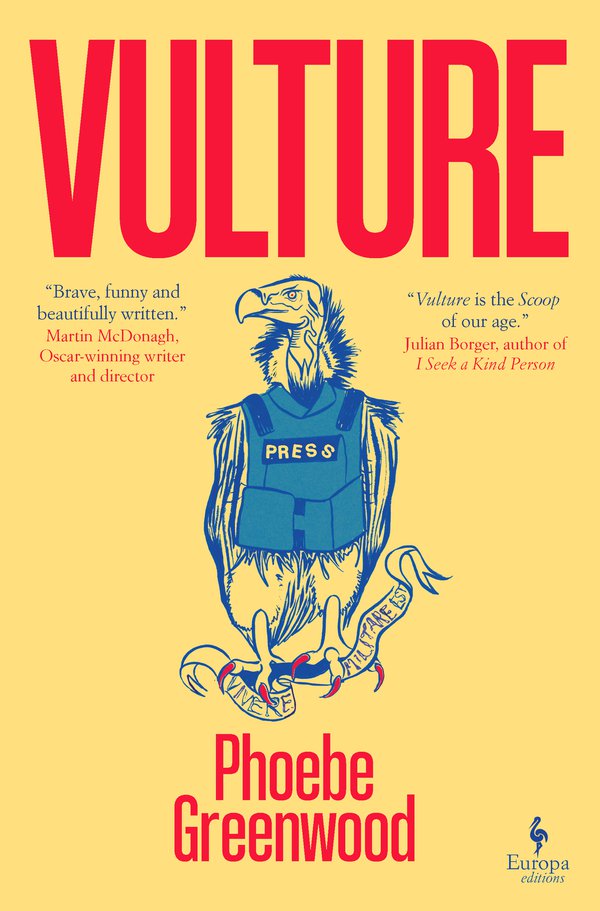
Vulture — Phoebe Greenwood
Europa Editions: Aug. 12, 2025
256 pages, $27.00
Vulture makes a nice pairing with Discontent. Sara Byrne, like author Phoebe Greenwood, is a British freelance journalist based in Jerusalem who volunteers to cover the hostilities in Gaza during 2012. Bored and frustrated after writing too many stories about death, destruction, and corruption, she is desperate for a big story that will prove she is a serious journalist and impress her ex. She becomes convinced that the answer is to gain access to the tunnels that Hamas has built underneath much of Gaza. When her local fixer, Nasser, refuses to risk his life to assist her in that dangerous plan, she contacts the son of a militant leader.
Vulture is an unsparing look at Western media’s cynical approach to war coverage. There are sympathetic and unsympathetic characters in both Israel and Gaza. The journalists covering the war, on the other hand, are nearly all contemptible. Some, like Sara, are ruthless in their ambition. Others are careless and jaundiced in both their personal and professional lives. Several spend too much time in the safe haven of the Beach Hotel’s bar. Particularly interesting is the perspective of Nasser and the hotel employees toward these foreign journalists, Western governments and NGOs, and the war itself. Vulture may be set more than a decade ago, but it’s as timely as today’s front page news.
Here are a couple excerpts from Discontent:
“I loathe the dynamics of meetings. I think some people enjoy them because they’re a way to avoid working. I think other people use meetings as a self-love bath, to feel important. I can’t stand the smorgasbord of cliches, the typical funny stories, the Anglicisms to try to add significance to the simplest procedures, the need to involve the pope and his mother in every minor project, or the tennis match that develops when someone wants to pass the buck and it gets lobbed right back.”
“As I’ve gotten older, I’ve noticed the widening gap between mothers and non-mothers. When you get to a certain age, not having children and not wanting them seems like an affront to the women who decide to have them. I’m aware that this is another tool of the patriarchy: divide and you shall conquer.
“That said, I’m fed up with the mothers around me. The ones in my office become a portal to their babies. Through them, you learn every milestone in the infant’s life, all explained in full detail, but which are actually completely run-of-the-mill: talking, walking, eating solid foods, gaining weight from one month to the next, not dying suddenly. Within this new dimension, Motherhood becomes the only religion and the New Moms are like missionaries in the colonial era. They spread their message of the benevolence of motherhood through the repetition of slogans: ‘This is the best thing that ever happened to me.’ ‘Sometimes I get stressed out, sure, but when I see my baby’s little face, that makes it all better.’ ‘You realize that you didn’t really know what love is.’ ‘Your old problems cease to matter.’ Having these women with dark circles down to their feet and more roots in their hair than a weeping willow talk to me about the perks of being a mother makes me distrust them. I don’t understand why they want to sell me their product with such passion. There must be a catch.”
 READ HER LIKE AN OPEN BOOK